


Twin Arrows forum puts Navajo contracting, election systems under scrutiny
Navajo Times | Krista Allen
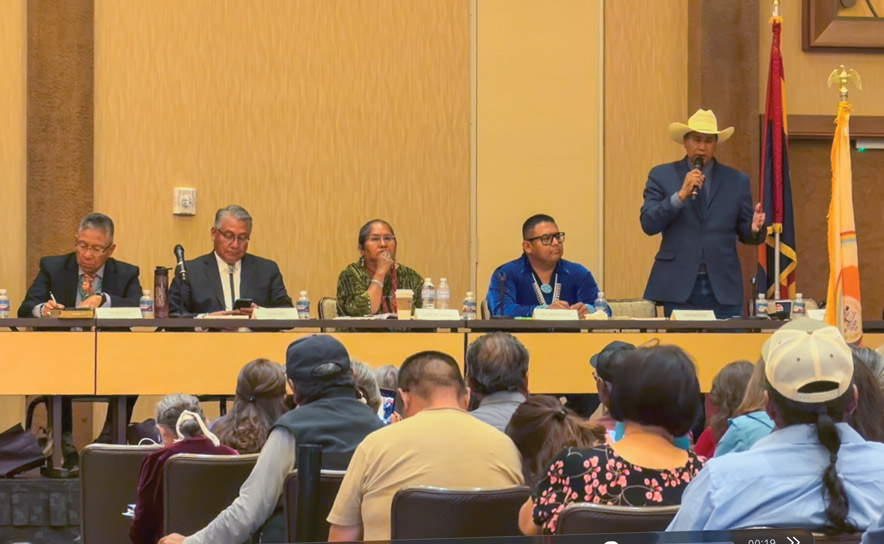
Navajo Nation presidential candidate Donovan Begay answers a question during Change Labs’ forum on the Diné economy Friday, July 17, at Twin Arrows Navajo Casino Resort.
FLAGSTAFF
Voters and business owners raised concerns about contracting, elections and land policy Friday at Change Labs’ Navajo Nation presidential candidate forum at Twin Arrows Navajo Casino Resort.
Robert and Margie Barton, the owners of Barton Southwest Builders, said their firm has repeatedly been passed over for Navajo Nation work despite its Priority One status. The couple has operated the Diné-owned general contracting company in Dilkon, Arizona, for 25 years.
Robert Barton, a journeyman carpenter, said the repeated rejections have taken a personal toll.
“I’m a licensed contractor. I build homes,” he said. “I’ve been building houses all these years, but yet I’ve never been chosen. That makes me feel bad and angry.”
He said he raised the issue with the president’s office and at public events in Tuba City and Shiprock.
“No response,” he said. “It needs to be restructured somehow.”
Margie Barton said the company submitted a complete bid package for housing work funded through the American Rescue Plan Act but was not selected. Barton Southwest Builders appears on the Business Regulatory Department’s Source List of certified Navajo businesses, revised July 9, as one of 36 general contractors with Priority One designation, which is reserved for firms that are fully Diné-owned and controlled.
Margie Barton said the Nation’s payment practices leave contractors covering project costs while they wait for reimbursement. Suppliers must be paid within a month, and workers must be paid weekly, she said, while the Nation pays only after inspection and often delays payment further.
“We do the work, they get inspected, and then we wait and wait and wait for payment,” she said. “So we become the finance company for the Navajo Nation.”
Asked whether the 164 review process was to blame for the delays, she declined to speculate.
“A contract is a contract. When the contract says you pay them on this date, that should be the case,” she said.
Margie Barton also questioned who oversees major construction projects.
“They have put big projects in the hands of directors, in the hands of program managers that have never ever constructed anything,” she said.
She called for a department staffed by construction professionals, and her criticism extended to the Council.
“Now you have Council delegates that are actually trying to be the construction company. They’re lawmakers,” she said. “They should be the oversight.”
Margie Barton said the next administration should follow the priority preference list and the Navajo Preference in Employment Act while providing fair contracts.
Navajo Nation officials raised similar concerns at the Nation’s economic summit June 9. Sharlene Begay-Platero, the executive director of the Navajo Division of Economic Development, linked many barriers facing Diné businesses to the status of the land.
“You have to lease all the land on Navajo,” she said. “It’s really owned by the federal government in trust for the Nation.”
Because trust land generally cannot be pledged as collateral, Begay-Platero said Diné entrepreneurs struggle to obtain capital and attract outside investment.
Council Delegate Otto Tso pointed to federal rules governing leases.
“The federal CFR continues to govern how business is done on the Navajo Nation,” he said, referring to the Code of Federal Regulations governing leases on trust land.

Navajo Times | Krista Allen
Voters fill the ballroom as Navajo Nation presidential candidates take part in Change Labs’ forum on the Diné economy Friday, July 17, at Twin Arrows Navajo Casino Resort.
Tso said investors are reluctant to invest on trust land. He said securing a business site lease could take about five years, while a business outside the Nation could open a storefront within two months.
Asked about the Nation’s roughly $10 billion in funds, Begay-Platero said the problem is how the money is used.
“We’re not using our billions as collateral to get other money,” she said.
Tso said the 164 review process can also delay projects. He recalled one review that remained at the Department of Justice for three months before he intervened and said each reviewing office should be required to act within days or forfeit its review.
A presidential candidate briefing prepared by Change Labs, a nonprofit that works with Native entrepreneurs, identifies many of the same barriers. The briefing reports that the Navajo Nation ranks in the bottom 15% of nations worldwide for the difficulty of starting and growing a business. It cites limited collateral, business site lease delays, high commercial rents and outdated payment and registration processes.
The briefing also examines the Navajo Small Business Credit Initiative, the Nation’s share of the federal State Small Business Credit Initiative. Change Labs reported that the Nation had drawn about $26.2 million of an $88.7 million allocation and deployed about $6 million to 44 businesses.
Election process draws criticism
Rosanna Jumbo-Fitch, a former Navajo Nation presidential candidate, said little has changed since she and other candidates questioned the Nation’s election process four years ago.
“I don’t see any improvements,” she said. “It’s the same exact process, asking for funding last minute, same amount, same people.”
Jumbo-Fitch said election offices continue to struggle to recruit poll workers and measures candidates sought to improve accountability never became Navajo law.
She also compared how former President Jonathan Nez and President Buu Nygren responded to concerns in Chinle.
“He came out to my chapter three times without question. He answered my call, answered my emails in the middle of the night,” she said of Nez.
“Not one response and not one sense of urgency for our concerns at Chinle,” she said of Nygren.
Jumbo-Fitch said the contrast shaped what she expects from the next president.
“Remain true and accountable to the people, not playing the game of favoritism,” she said.
Zunneh-Bah Jim, a young Diné voter attending her first presidential forum of the election, had already cast an early ballot. Jim said she voted early after missing the absentee ballot deadline. Poll workers told her she could not cast a ballot without a photo ID.
“Not once in my whole lifetime have I ever been asked to provide my photo ID,” she said.
Jim refused to provide the ID and instead gave her census number, Social Security number, residential address and chapter of enrollment. She said those are the details required under Title 11 of the Navajo Election Code. When she asked poll workers to identify a law requiring photo identification, she said they could not.
“Reluctantly, they gave me my ballot and I voted,” she said.
Jim said she later reviewed Title 11 and posted the relevant sections on social media because she worried other voters might have been turned away.
“How many first-time voters forgot their ID or didn’t want to provide it either and got turned away?” she said. “That’s how we lose voters.”
Get instant access to this story by purchasing one of our many e-edition subscriptions HERE at our Navajo Times Store.

 Highway 264,
 I-40, WB @ Winslow